

When pipeline is low, the usual reaction is:
“We need more leads.”
So the team buys another database, gets more contacts, sends more emails, and asks SDRs to increase activity.
I’ve seen this approach repeatedly in SaaS sales.
And usually, more activity doesn’t fix the problem.
Because before asking how to contact more people, you need to answer:
Are we even contacting the right people in the first place?
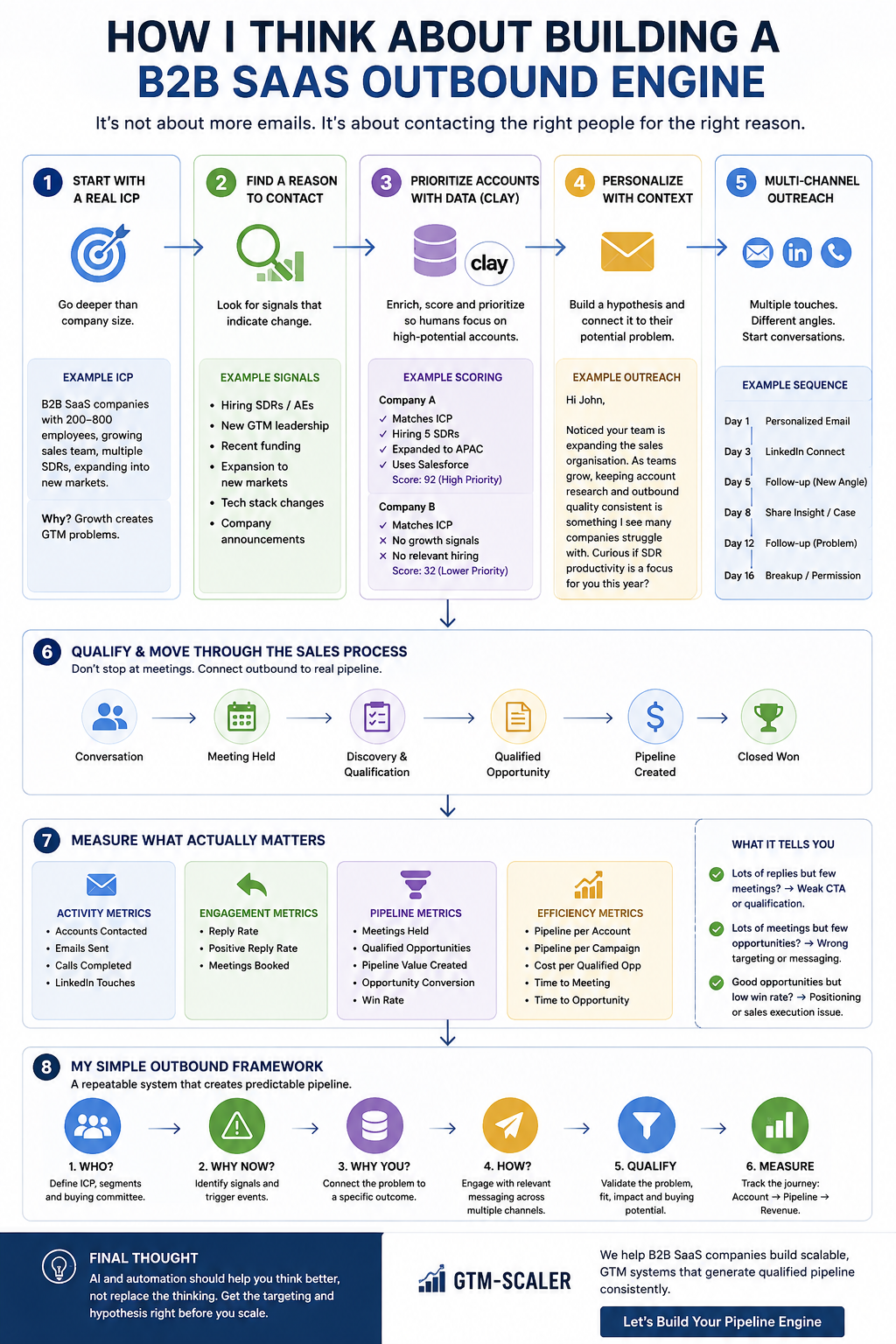
Start With a Real ICP, Not “Companies With 100+ Employees”
Let’s say you’re selling a GTM automation solution.
A generic ICP might be:
B2B SaaS companies with 100–1,000 employees.
That’s potentially thousands of companies.
But not all of them have the same problem.
I would go deeper.
For example, a higher-priority account could look like:
A B2B SaaS company with 200–800 employees, a growing sales team, multiple SDRs, and signs they are expanding into a new market.
Why?
Because growth often creates GTM problems.
More reps mean more prospecting. More prospecting means more account research, inconsistent messaging, duplicate work, and messy data.
Now you have a reason to reach out.
Don’t Just Build a List. Find a Reason to Contact Them.
One of the biggest changes I’ve made in how I think about outbound is moving away from:
“Who should I email today?”
towards:
“Why would this company care about solving this problem now?”
For example, imagine you find a company hiring:
- 5 SDRs
- 2 Account Executives
- A Head of Revenue Operations
That’s more interesting than simply knowing they have 500 employees.
The hiring activity could indicate they are investing in building their GTM motion.
You could then build a hypothesis:
“As the team scales, maintaining consistent account research and personalization across reps may become more challenging.”
Your outreach now has context.
Instead of:
Hi John, I came across your profile and noticed you’re VP of Sales at Company X. We help companies automate outbound…
You could say:
Hi John, noticed your team is actively expanding the sales organisation. When SaaS teams add more SDRs, one challenge I often see is keeping account research and outbound quality consistent without creating more manual work for the team. Curious if improving SDR productivity is something you’re looking at this year?
That’s not magic personalization.
It’s simply having a reasonable hypothesis before reaching out.
This Is How I Would Use Clay
I wouldn’t use Clay just to find 10,000 email addresses.
That’s a waste of what the platform can potentially do.
I would use it to help answer:
Which accounts deserve my attention?
For example, imagine I have 2,000 target SaaS accounts.
I could enrich them with information such as:
- Employee growth
- Recent funding
- Open sales and SDR roles
- New GTM leadership
- Technologies used
- Recent company announcements
Then I can score them.
Example:
Company A
- Matches ICP
- Hiring 5 SDRs
- Recently expanded into APAC
- Uses Salesforce
Company B
- Matches ICP
- No visible growth signals
- No relevant hiring
- No obvious trigger
Both technically fit the ICP.
But I know where my team should spend more effort first.
Company A gets priority.
That is how I think automation should work:
Automate the research and prioritisation. Keep humans focused on the conversation and judgement.
The Outbound Metrics I Actually Care About
A campaign can have a great open rate and still create zero revenue.
That’s why I wouldn’t judge outbound success based only on:
- Emails sent
- Open rates
- Replies
The numbers I care more about are:
1. Positive conversations
Are the right people actually responding?
2. Meetings held
Did they genuinely show up and engage?
3. Qualified opportunities created
Did the meeting uncover a real problem worth solving?
4. Pipeline created
Is outbound contributing actual revenue potential?
For example:
1,000 emails → 40 positive replies → 12 meetings → 5 qualified opportunities → $200K pipeline
That tells me much more than:
“We achieved a 60% open rate.”
And if I see:
1,000 emails → 20 meetings → 0 qualified opportunities
I don’t immediately tell the SDR:
“Book more meetings.”
I go back and investigate the system.
Maybe the ICP is wrong.
Maybe the messaging is attracting the wrong people.
Maybe the SDR qualification process is too loose.
Outbound problems are often funnel problems, not activity problems.
My Simple Framework for Building an Outbound Engine
This is how I think about it:
1. Who?
Define the ICP clearly.
Not just industry and company size.
Understand what characteristics make a company likely to have the problem you solve.
2. Why now?
Look for signals.
Hiring, expansion, funding, leadership changes, technology changes—anything that gives you a reasonable hypothesis for why the problem may matter now.
3. Why you?
Connect the potential problem to a specific outcome your solution can deliver.
Not a list of features.
A business outcome.
4. What happened next?
Track the entire journey.
Account → Conversation → Meeting → Qualified Opportunity → Pipeline
If something isn’t converting, find the bottleneck.
Don’t blindly increase volume.
The Biggest Mistake I See With AI Outbound
AI makes it incredibly easy to generate more outbound.
That’s exactly why I think GTM teams need to be careful.
You can now research 10,000 accounts.
Generate 10,000 personalized emails.
Launch everything in a few hours.
But if your ICP and hypothesis are weak, AI just helps you send irrelevant messages faster.
The goal shouldn’t be:
“How can we automate everything?”
The better question is:
“Where should we use automation so our team can spend more time on high-value work?”
For me, AI and automation are great for:
- Research
- Data enrichment
- Account prioritisation
- First-draft personalization
- Identifying patterns
But I still believe humans need to own:
- ICP decisions
- Customer understanding
- Sales conversations
- Complex qualification
- Strategic judgement
Final Thought
A predictable outbound engine isn’t built by finding more contacts.
It’s built by consistently answering:
Who is most likely to have this problem?
Why might they care now?
What evidence supports that hypothesis?
What happens after we start the conversation?
Get those four things right before scaling.
Then use tools like Clay, AI, and automation to make the process faster.
Not to replace the thinking behind it.
Need Help Building Your GTM Engine?
At GTM-Scaler, we help B2B SaaS teams connect ICP strategy, account prioritisation, GTM automation, outbound execution, and sales process into one repeatable system.
Because sending more emails is easy.
Building a system that creates qualified pipeline is the hard part—and that’s where the real work begins.
Leave a Reply