
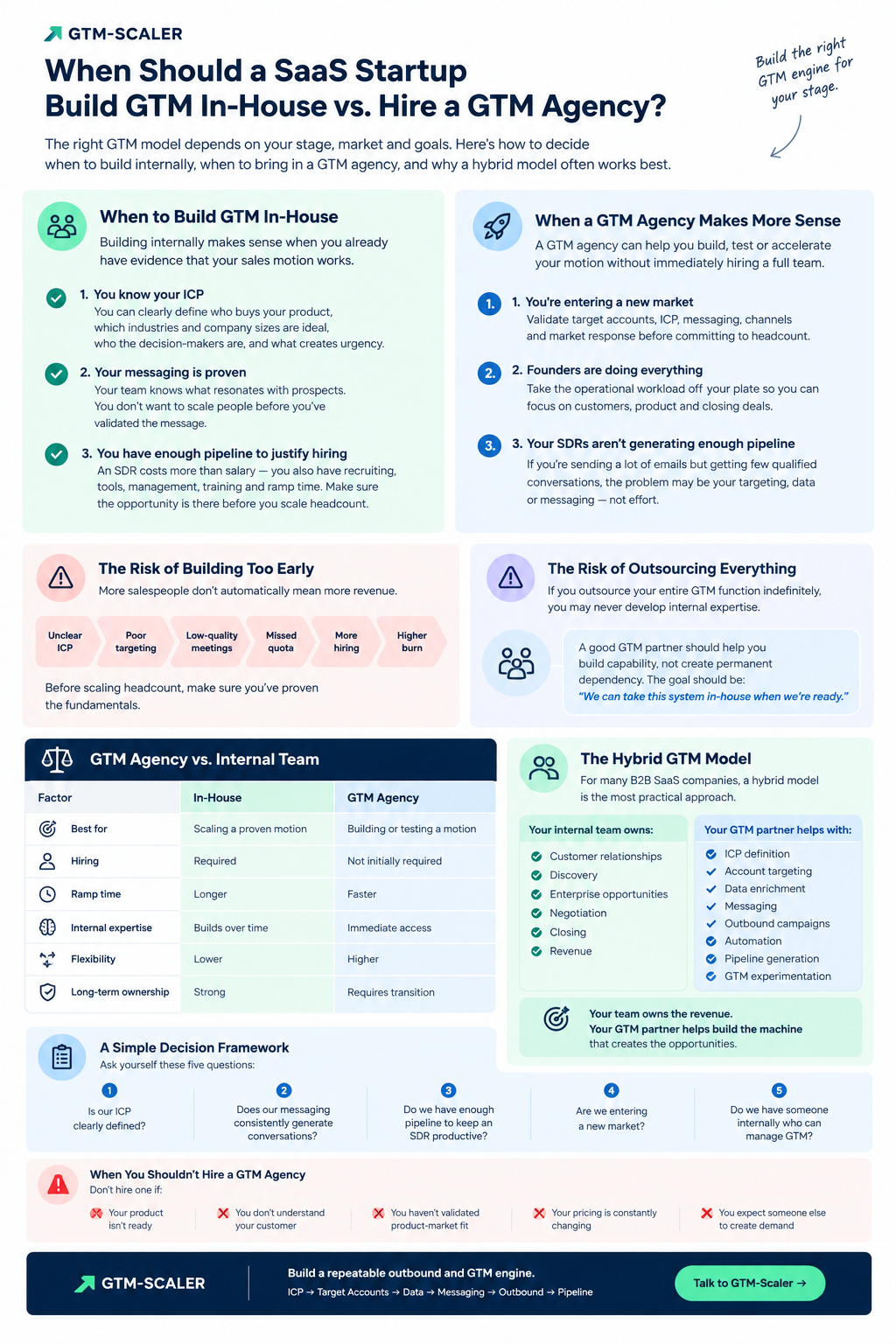
For B2B SaaS companies, the question isn’t whether you need a go-to-market strategy.
The real question is:
Should you build your GTM engine internally, or bring in external expertise to build and accelerate it?
The answer depends on where your company is today.
If your ICP, messaging and sales motion are already proven, building internally can make sense. If you’re still figuring out your market, struggling with pipeline or entering a new territory, a GTM agency can help you move faster without immediately committing to a large sales team.
For many companies, the best answer is a hybrid GTM model.

When You Should Build GTM In-House
Building internally makes sense when you already have evidence that your sales motion works.
1. You know your ICP
You should clearly understand:
- Who buys your product
- Which industries convert best
- Which company sizes are ideal
- Who the decision-makers are
- What problems create buying urgency
If your ICP is simply “any company that could use our product,” you’re probably not ready to scale an outbound team.
2. Your messaging is proven
Your sales team should already know what resonates with prospects.
You don’t want to hire five SDRs only to discover that nobody has figured out what to say.
Prove the message first. Then scale the people executing it.
3. You have enough pipeline to justify hiring
An SDR costs more than salary.
You also have recruiting, tools, management, training and ramp time.
If you haven’t proven your outbound motion yet, you’re effectively paying employees to experiment.
That may be worthwhile—but you should recognize the cost.
When a GTM Agency Makes More Sense
A GTM agency can be useful when you need to build, test or accelerate your GTM motion without immediately hiring a full team.
1. You’re entering a new market
If you’ve proven your product in one market but want to expand into another, an agency can help validate:
- Target accounts
- ICP
- Messaging
- Sales channels
- Market response
This lets you test the opportunity before committing to permanent headcount.
2. Founders are doing everything
Many early-stage founders become their own SDR, AE, RevOps manager and marketer.
They spend hours researching accounts and sending outbound messages instead of focusing on customers, product and closing strategic deals.
A GTM partner can take the operational workload off their plate.
3. Your SDRs aren’t generating enough pipeline
If your team is sending hundreds of emails but producing very few qualified conversations, the problem may not be activity.
It could be:
Wrong ICP → Wrong accounts → Poor data → Weak messaging → Low response → Low pipeline
Hiring more SDRs won’t necessarily fix the underlying problem.
The Risk of Building Too Early
More salespeople don’t automatically mean more revenue.
If your GTM strategy isn’t working, adding more people simply increases the number of people executing an unproven process.
You can end up with:
Unclear ICP → Poor targeting → Low-quality meetings → Missed quota → More hiring → Higher burn
Before scaling headcount, make sure you’ve proven the fundamentals.
The Risk of Outsourcing Everything
The opposite approach has its own problems.
If you outsource your entire GTM function indefinitely, your internal team may never develop the expertise to run it themselves.
A good GTM partner should therefore help you build capability, not create permanent dependency.
The goal should eventually be:
“We can take this system in-house when we’re ready.”
GTM Agency vs. Internal Team
| In-House | GTM Agency | |
|---|---|---|
| Best for | Scaling a proven motion | Building or testing a motion |
| Hiring | Required | Not initially required |
| Ramp time | Longer | Faster |
| Internal expertise | Builds over time | Immediate access |
| Flexibility | Lower | Higher |
| Long-term ownership | Strong | Requires transition |
The question isn’t simply “build or buy?”
It’s:
“What should we own today, and what should we outsource until we’re ready to own it?”
The Hybrid GTM Model
For many B2B SaaS companies, a hybrid model makes the most sense.
Your internal team owns:
- Customer relationships
- Discovery
- Enterprise opportunities
- Negotiation
- Closing
- Revenue
Your GTM partner helps with:
- ICP definition
- Account targeting
- Data enrichment
- Messaging
- Outbound campaigns
- Automation
- Pipeline generation
- GTM experimentation
In simple terms:
Your team owns the revenue.
Your GTM partner helps build the machine that creates the opportunities.
A Simple Decision Framework
Ask yourself five questions:
1. Is our ICP clearly defined?
If yes, internal hiring becomes more attractive.
2. Does our messaging consistently generate conversations?
If no, validate the messaging before scaling headcount.
3. Do we have enough pipeline to keep an SDR productive?
If no, fix the GTM engine first.
4. Are we entering a new market?
If yes, external expertise can reduce the cost and risk of experimentation.
5. Do we have someone internally who can manage GTM?
If no, consider bringing in external expertise while you build that capability.
When You Shouldn’t Hire a GTM Agency
A GTM agency can’t solve every problem.
Don’t hire one if:
- Your product isn’t ready
- You don’t understand your customer
- You haven’t validated product-market fit
- Your pricing is constantly changing
- You expect someone else to magically create demand
An agency can accelerate a GTM motion.
It can’t manufacture product-market fit.
When GTM-Scaler Can Help
At GTM-Scaler, we help B2B companies build a repeatable outbound and GTM engine.
We focus on the fundamentals:
ICP → Target Accounts → Data → Messaging → Outbound → Pipeline
Instead of simply providing a list of leads, we help companies build a system they can eventually operate and scale internally.
Whether you’re entering a new market, struggling with outbound or deciding whether to hire your first SDR team, the goal is the same:
Build a GTM engine that produces predictable pipeline.
Leave a Reply