
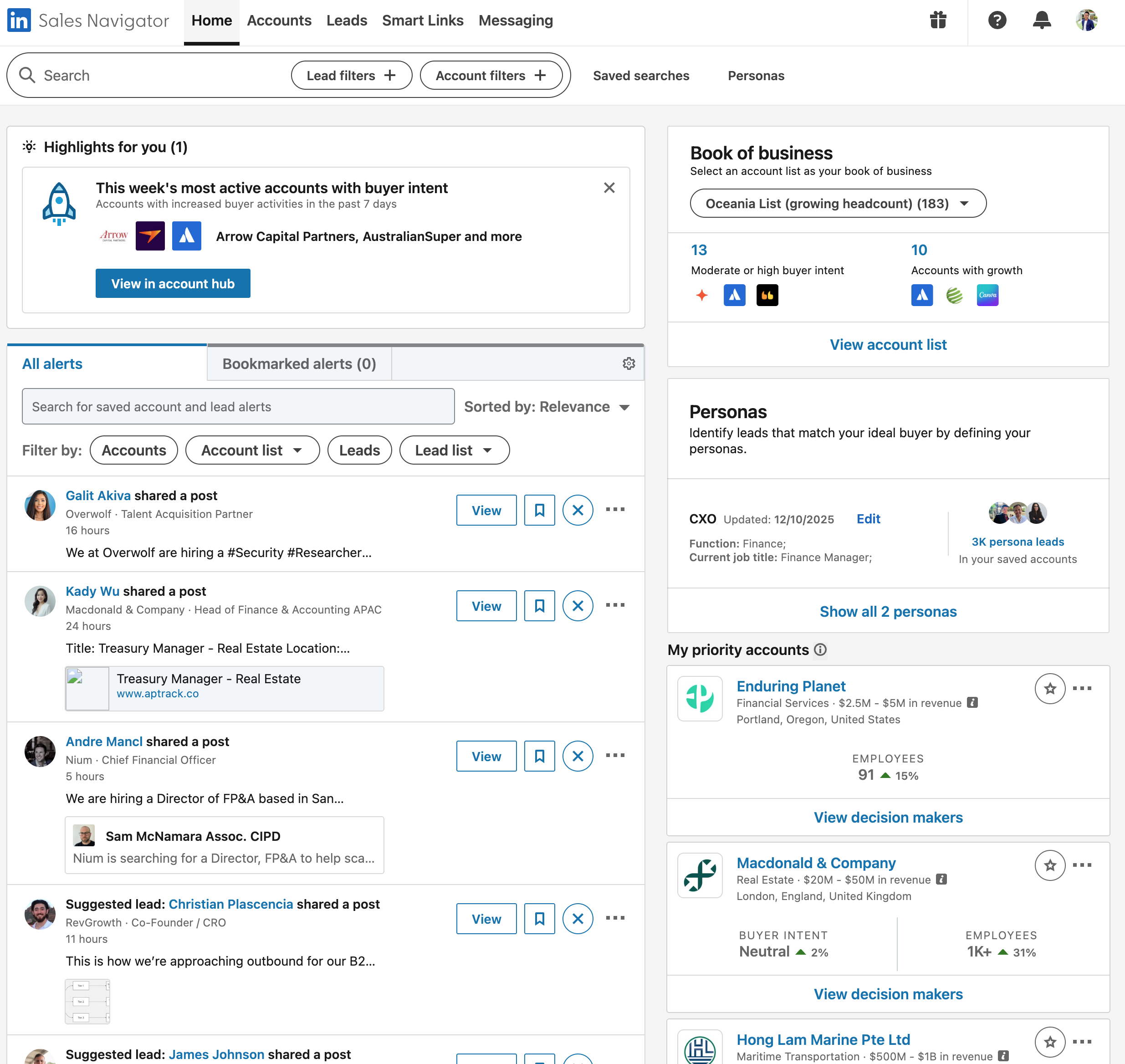
If you’re in B2B sales especially in SaaS, chances are you’re already using LinkedIn in some form. But there’s a big difference between casually using normal LinkedIn and intentionally using LinkedIn Sales Navigator as a core part of your outbound motion.
Many sellers start with normal LinkedIn, only to realize that as they scale their outreach, it quickly becomes limiting. That’s where Sales Navigator comes in.
This post breaks down the practical benefits of Sales Navigator compared to regular LinkedIn, and why it’s a game-changer for outbound sales teams.

Normal LinkedIn: Great for networking, limited for selling
Regular LinkedIn is excellent for:
- Personal branding
- Networking
- Staying updated with your industry
- Engaging with posts and thought leadership
- Keeping in touch with existing contacts
However, when it comes to structured prospecting and outbound sales, normal LinkedIn falls short. You quickly run into issues like:
- Limited search filters
- Restricted profile views
- Lack of structured lead tracking
- No systematic way to monitor buying signals
- Minimal collaboration features for sales teams
In short, normal LinkedIn is built for professionals, not for sales teams.
Sales Navigator: Built specifically for outbound selling
Sales Navigator transforms LinkedIn from a networking platform into a powerful sales intelligence and prospecting tool.
Here’s why it’s superior.
1) More precise targeting with advanced filters
With Sales Navigator, you can build highly specific lists of your ideal customers based on criteria such as:
- Company size
- Industry
- Job function
- Seniority level
- Years in role
- Growth signals
- Geography
For example, instead of vaguely searching for “Finance Director,” you can target something like:
“Finance Directors in mid-sized F&B companies in Southeast Asia with 200–1,000 employees.”
This level of precision dramatically improves the quality of your outreach and reduces wasted effort.
2) Access to more profiles with fewer restrictions
Regular LinkedIn users often hit search limits quickly, especially when prospecting heavily.
Sales Navigator significantly increases these limits, allowing you to:
- View more profiles
- Search more freely
- Prospect without constant interruptions
This makes a huge difference for SDRs, AEs, and anyone doing high-volume outreach.
3) Lead and account tracking
One of the most valuable features of Sales Navigator is the ability to save Leads and Accounts.
Once saved, you can receive alerts when:
- A prospect changes jobs
- Gets promoted
- Posts on LinkedIn
- Appears in the news
This enables much more contextual outreach, such as:
- “Congrats on your new role — how has the transition been?”
- “Saw your company just raised funding — how are you thinking about scaling operations?”
Normal LinkedIn offers no structured way to track this at scale.
4) Real-time buying and engagement signals
Sales Navigator surfaces key signals that are extremely useful for outbound, including:
- Recent posts
- Job changes
- Company news
- Hiring activity
- Engagement with your company page
These signals help you reach out at the right moment rather than randomly messaging prospects.
5) Better collaboration for sales teams
For organizations using Sales Navigator Team plans, multiple reps can:
- Share lead lists
- Add notes on accounts
- Avoid duplicate outreach
- Align on priority targets
This makes prospecting far more organized and efficient compared to normal LinkedIn.
6) CRM integration
Sales Navigator integrates with tools like Salesforce and HubSpot, allowing sales teams to:
- Sync leads and accounts
- Log activities automatically
- Reduce manual data entry
- Keep pipelines cleaner and more accurate
Normal LinkedIn simply doesn’t offer this level of integration.
7) Improved access to decision-makers via InMail
Sales Navigator provides more InMail credits and better messaging access, making it easier to reach people outside your immediate network.
With normal LinkedIn, you’re often restricted to:
- Messaging only your direct connections
- Limited InMail unless you pay for Premium
For serious outbound, Sales Navigator is far more effective.
The bottom line
If normal LinkedIn is a social and professional networking tool, Sales Navigator is a sales platform.
A simple way to think about it:
Normal LinkedIn = good for networking
Sales Navigator = built for outbound selling
Or another analogy:
If normal LinkedIn is a map, Sales Navigator is a GPS for sales.
Final takeaway
If your company is serious about outbound — especially in B2B SaaS — Sales Navigator isn’t a “nice to have.” It’s a core part of your tech stack.
It gives you:
- Better targeting
- More control
- Richer signals
- Stronger collaboration
- And ultimately, a more predictable outbound motion
If you’d like, I can:
- Tailor this for your GTM-Scaler narrative
- Make it more formal for a website
- Turn this into slides
- Or rewrite it in a more conversational style.