
A prospect accepts a meeting, asks sensible questions, and agrees that your product looks useful. Should that conversation become a qualified opportunity?
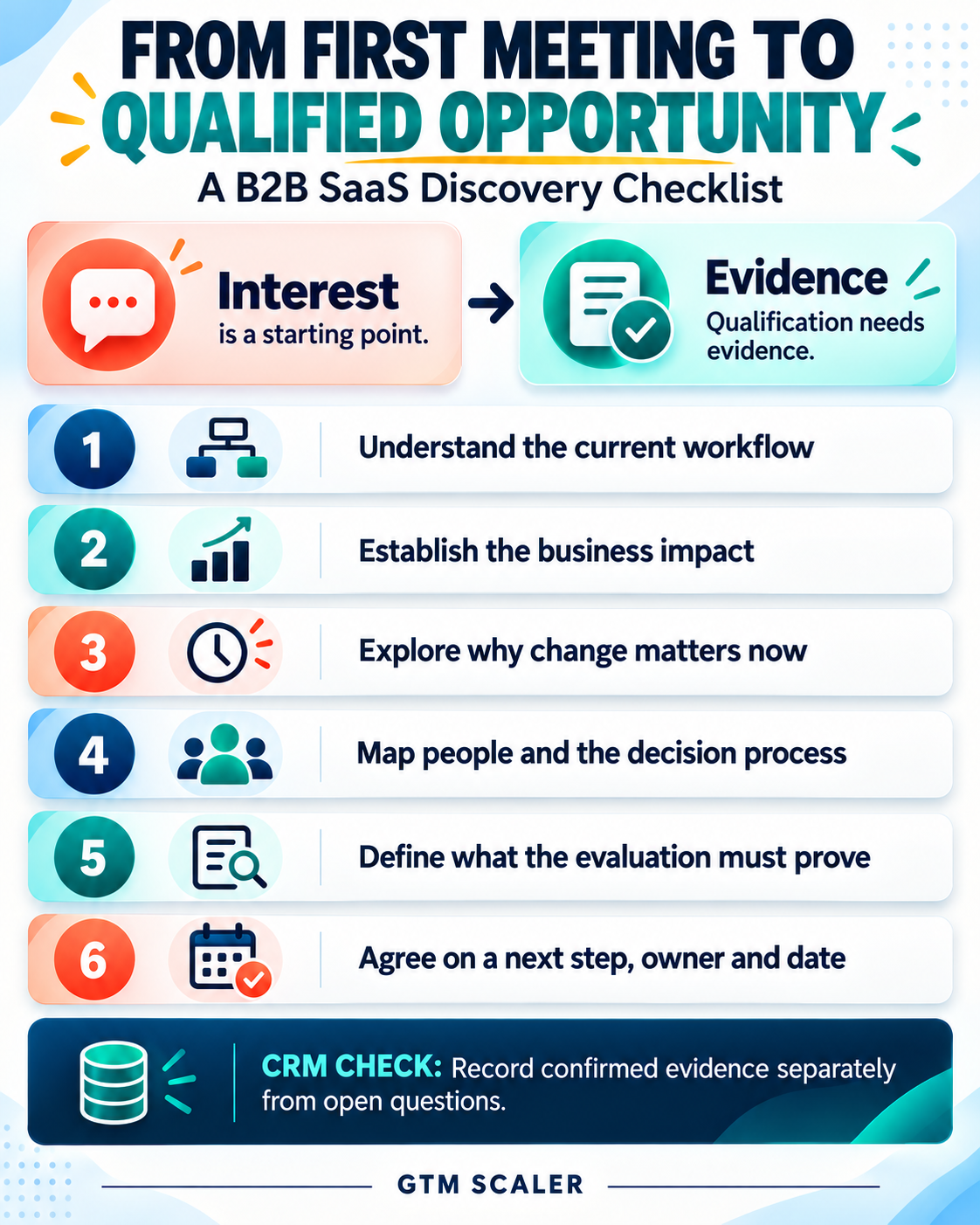
Before you move the deal forward in your CRM, establish what the buyer actually wants to change. Interest is a starting point. Qualification needs evidence that there is a problem worth solving and a plausible path to a decision.
Use the following checklist to structure discovery. Treat it as a guide to a conversation, rather than a form the prospect must complete.
1. Understand the current workflow
Ask the buyer to walk through a recent example of the process your product could improve. Specific examples give you something concrete to investigate.
- How does the work get done today?
- Who is involved, and where does the handoff happen?
- What triggered the decision to explore another approach?
For example, imagine a SaaS company reviewing its account research process. “We want better automation” is broad. Learning that sales reps reconcile three separate spreadsheets before each campaign gives you a specific workflow to discuss.
2. Establish the business impact
A frustrating process does not automatically justify a purchase. Explore what the problem affects and how the team assesses its importance.
Ask which consequences matter: time spent, delayed follow-up, inconsistent data, missed handoffs, or another outcome the buyer identifies. Then ask how they measure it.
If the buyer estimates that each rep spends several hours a week on manual research, record that as an estimate to validate. Avoid turning an unverified assumption into a promised saving or a return-on-investment claim.
3. Explore why a change matters now
Find out whether there is a real reason to act within a particular period.
- Is an existing contract approaching renewal?
- Is the team preparing for a new market or sales campaign?
- Does another project depend on fixing this workflow?
- What happens if the team continues with the current approach?
A hiring announcement or expansion plan can suggest a useful question. It does not prove that the company has budget or buying intent. Let the buyer explain the connection.
4. Map the people and the decision process
The person attending discovery may be a future user, an evaluator, a project owner, or the person approving the spend. Establish their role without dismissing their contribution.
Ask who else would help evaluate a change and what each person needs to understand. Depending on the purchase, the process might involve sales leadership, operations, finance, IT, security, or procurement.
You do not need every answer during the first call. You do need to distinguish what the buyer has confirmed from what you still need to learn.
5. Define what a useful evaluation would demonstrate
Make the next demonstration or trial relevant to the buyer’s workflow.
In the account research example, the buyer might want to test whether a small set of approved accounts can move through research, review, and CRM entry with fewer manual steps. Agree on what to observe, who will assess the result, and what limitations need checking.
Keep technical fit, business value, and implementation effort visible. A successful demonstration alone does not establish that the buyer can deploy or purchase the solution.
6. Agree on a concrete next step
Before ending the call, agree on an action, an owner, and a date. The action should help both sides resolve something that matters to the decision.
For example: the prospect shares a sample workflow, the seller prepares a focused demonstration, and the operations lead joins the next conversation to assess the proposed handoff.
If the buyer is only gathering information, reflect that in your follow-up and CRM stage. Continue the relationship at a pace that matches their situation.
Capture evidence in the CRM
After discovery, write a short note covering the confirmed problem, its impact, the reason to act, the people involved, and the agreed next step. Add a separate list of open questions.
Use your team’s stage criteria consistently. An unknown should remain an unknown until it is verified; filling every field is less useful than keeping an accurate account of the conversation.
This checklist complements the work of choosing the right accounts for outbound. Targeting gives you a reason to start a conversation. Discovery helps you assess whether there is a worthwhile opportunity to pursue together.
Want help defining qualification criteria and connecting them to your sales workflow? Explore GTM Scaler’s consulting and implementation services.
Leave a Reply